Some techniques to try when the words don’t flow…
…collected together from my troubled academic writing career.
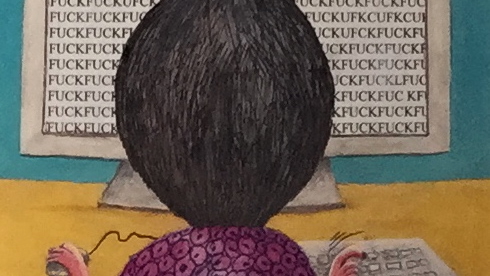
Cover image: Detail from the card a friend gave me at some point while I was writing (or, more often, not writing) my PhD.
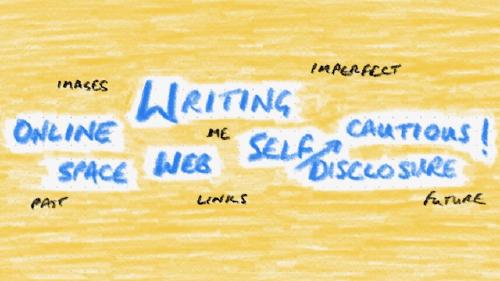
Clearly I’m facing some of my own writing trouble again… even the title of this post was difficult and I swithered between “Writing woes”, “Writing trouble” (too often used by others), “Writing torment”, “Writing anxiety”. I went with “Writing…” until I remembered I’d worked out something more descriptive a few weeks ago (when I originally meant to post this).
I’ll say more about why I’ve got stuck with my website writing another time.
I might say something in the future about “AI” (scare quotes because that term deserves critical attention, not to be used without qualifiers) and writing too. I don’t use “AI” in my own writing, incidentally. Not here. Not anywhere.
For now, here is something I sent to a friend of mine whose daughter has been struggling with essay writing.
What problems have I had that made writing difficult?
- Writing block (ie unable to put words on the page at all)
- Structuring issues (ie unable to organise writing/notes into final form)
- Panic over too many resources and notes (stuck in research, not moving to writing itself)
- Procrastination (difficulty getting on with writing, research reading often easier than writing)
Here are some ideas/techniques I’ve tried to help with issues writing…
Not managing to try to write at all? Try a short writing starter session
Can be related to: general procrastination/feelings of fear/blank page issues/hypercritical focus on perfecting sentences for ages
To begin a writing session set a start time and promise yourself you only have to write for 20 minutes. Use a timer. Remove distractions if that’s an issue for you (eg phone/internet).
For me, doing this meant the pain I was anticipating was only going to last for 20 minutes. Then it would be over. This made it easier to start.
You may find you want to continue after the timer goes off, because actually it’s not as awful as you thought it’d be. You can try riding that wave and see what happens. If you start feeling bad then stop. Don’t be afraid to stop mid-sentence, because that can help when you return for another go.
If it was just as awful as you anticipated then stop. Schedule in another 20 minutes after a break. Try to keep scheduling and breaking down the anxious feeling gradually.
This is not exactly the pomodoro technique, although it could become that. I never got on well with pomodoros, but some people love them. I just needed to get myself writing at all.
Staring at a blank page for 20 minutes? Try free writing on topic
What is free writing in this context?
(Because I don’t mean writing about anything to get yourself writing at all. You can do this if you think it’ll help you, but I used to end up feeling it was a bit of a waste of time, because I could blather on about life, but where was that getting me when I needed to write an essay?)
Well, I’d describe it as writing about your research for yourself. The element of freedom is more in the style, rather than in the content. Don’t worry about being academic, don’t worry about your supervisor/marker reading it, use “I” to focus on your argument.
You can use this piece of writing later, rework it so that it fits into whatever style you need to use, but if you start like this it often is much easier. It also has the advantage of making you write about what you think, rather than just piecing together what other people have said.
Do you keep stopping and re-writing sentences/paragraphs? Try making it too difficult to read what you’ve written to go back to immediately
If you find that you can’t flow with your writing, ie you keep stopping, making corrections, going back and editing etc. then there are some weird things you can try!
- Use a white font on a white background
- Use a small font so that you can’t read exactly what you’ve written
This sounds extreme, but it helps if you find that you’re thinking too much while you’re writing. To begin with, maybe for all time actually, you want to write something that says roughly what you want it to say rather than being perfect. (Perfection is a false goal. Nothing is perfect. Imperfect writing exists, perfect writing doesn’t.)
You get to go back and edit in another session at another time. Just change the font colour back to black/reset the font size.
Manage to write a lot, but then get overwhelmed trying to put it into a final form? Try the Radical Chop-up Über Document (RCUD)
You may get words onto the page, but then struggle with getting them into the final form of an essay. Enter the Radical Chop-up Über Document (RCUD) (courtesy of my PhD supervisor).
- Create a new document.
- Save it, and make sure the name contains the word “radical” somewhere. Note that this is essential. It may sound silly, but you need to be reminded that what you are doing is “radical” otherwise you’re never going to chop it all up.
- Now open up your other documents in turn and cut and paste the best bits from them into your new document.
- But, as you do this you must be radical.
- Don’t take pieces that you don’t think are good enough.
- Feel free to write yourself notes in capitals.
- Put subtitles in for the sections as you add them.
- Reorder sections at will.
- Cut bits when you find you’ve written a better version elsewhere.
This means you retain your base documents. You’re not afraid of deleting something you might need later. You have a new document where you can add, cut, reorder, reword, etc freely and fearlessly.
(TBH you can drop the word radical whenever you like, but it was helpful the first time!)
Remember. All writing beyond something like a shopping list is creative. It doesn’t have to be a novel. Essays, reports, blogs, weeknotes can all be tricky to start… and then to finish. That means Toothpaste for Dinner’s “The creative process” timeline can apply to them all.
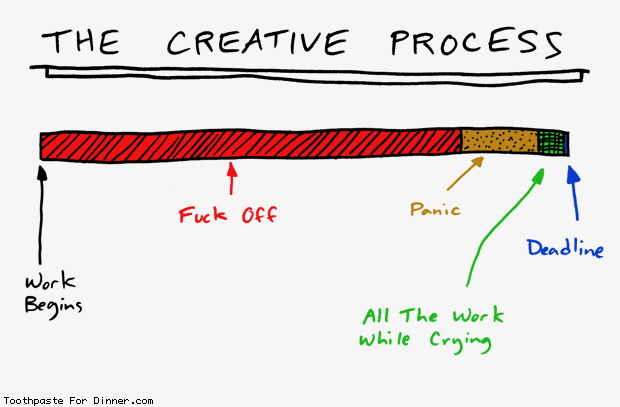
I spent my whole academic career attempting to break this cycle.
I failed.