These are my putting practice plans…
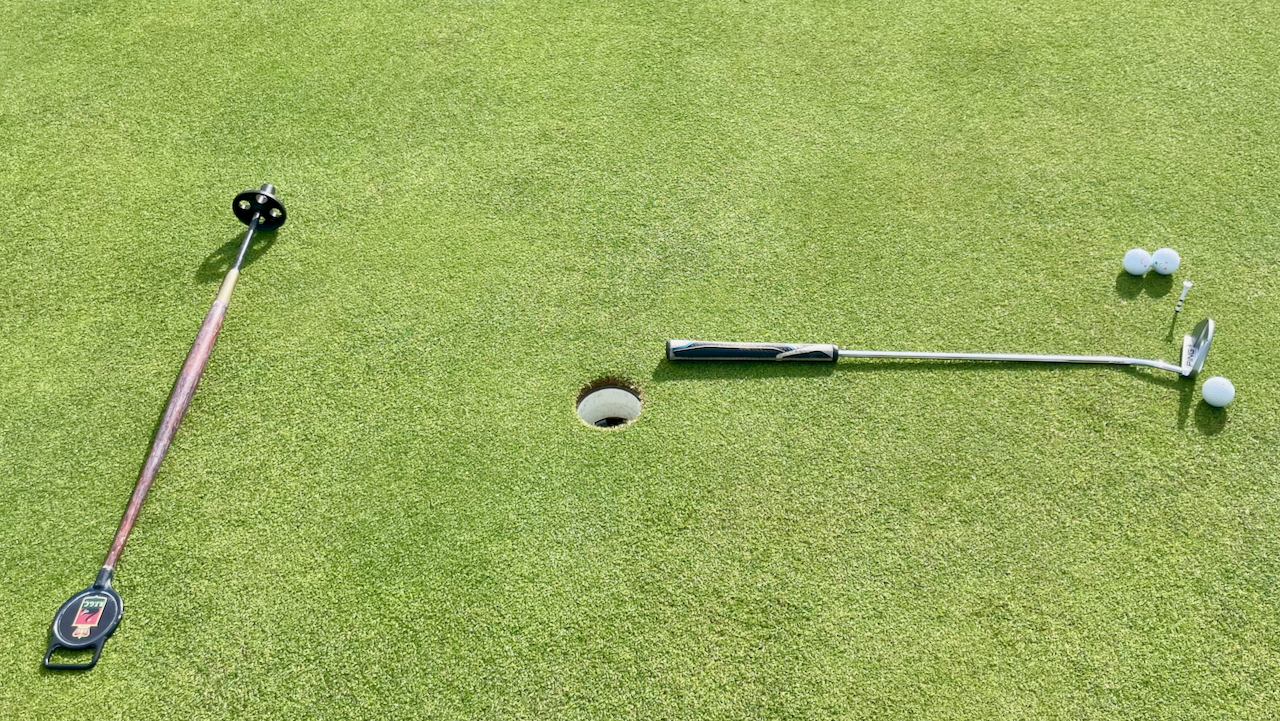
…for early 2026. (I’ve recycled an old image for the post, since the setup is still in use for part of the plan.)
Putting setup process
I’ve got a new process for setting up to putt. I’m holding the club at a different point on the grip (but still with a conventional putting grip). I repeat the same moves to take my stance each time. My stance is more stable than it was, with more connection between my arms and body at address. I have a rhythm to get ready and then take each putt (but this is developing as I practice, it’s not quite there yet). I have been working (!) on this for a little while across long and short putts, even from off the green. I know it has the potential to work well for me across all these variations.
Putting practice 1
Taking straight putts on the practice green (if time do this uphill and downhill) with a backstop 45-50 cm (18-20 inches) past the hole. This builds on my existing putting practice:
-
Putt 3 balls at 1x putter length (PL). Do the first set with eyes open, then a set with eyes closed. Always complete the whole setup process for every putt.
-
Repeat this at 2x PL, then 3x PL.
-
Repeat the whole set again if there’s time and it seems useful (or repeat specific distances if that makes more sense).
This is helping to build my understanding of how I putt in a somewhat controlled setting. The repetition means I get a sense each time I practice of how the ball rolls away from the club given the specific conditions. I’m building a consistent setup process for putting that’s giving me confidence in my body’s ability to know what it’s doing so I can take this confidence out on course.
Putting practice 2
Play the “two putt” putting game for two balls to holes at medium and long distance on the practice green.
-
Read each putt carefully (these are not straight). Complete the whole setup process for every putt.
-
Repeat for as many holes as you want across different lengths as seems appropriate to learn more and experience greater variability. Use eyes closed as an option when struggling with pace (since I find it particularly helpful when I keep leaving the ball short of the hole).
This practice gets the brain involved reading each putt. Once a decision is made for the line, seeing the whole line and how this passes across a visible mark on the green a little ahead of the ball, develop a sense of pace with brain and body by thinking about how to bowl a ball on that line into the hole. Then it’s a case of trusting the process, setting up for the chosen line and letting the body complete the task. The medium and long first putts are about getting the ball close to the hole to reduce the pressure on the second putt (playing the two-putt game, remember). That first putt might go in. It might end up nowhere near leaving a challenging second putt. However it goes, I think it’s a good way to prepare for playing on course wherever you find yourself initially (and wherever you leave yourself after that first attempt).
PAD analysis
Analysing the process, accuracy and distance (PAD) for each putt in the moment should help build learning and improving my process for setup, visualising and taking the shot.
Do I know what I’m doing?
No, because my putting process currently relies on an in the moment judgement of what needs to be done which is almost entirely visceral as opposed to controlled by conscious thought.
I had taken to keeping the word “soft” in mind for downhill putts (to help my body reduce pace for conditions it might lose track of in the moment), but recently I’ve just been visualising the roll needed (as little as that might be) and letting my body do its thing.
I’m going to stick with this practice for now (maybe for a long time), because my putting for my last two rounds was much better than in the past (even playing on courses I’m not familiar with at all).
I think these simple, playful practice ideas work well with my putting style. Better than tighter drills with mirrors, gates, lines, clock faces etc, which you see all over the place online.
I might be wrong!!